


Staff RN · Map My Pay Co-Founder · October 13, 2026
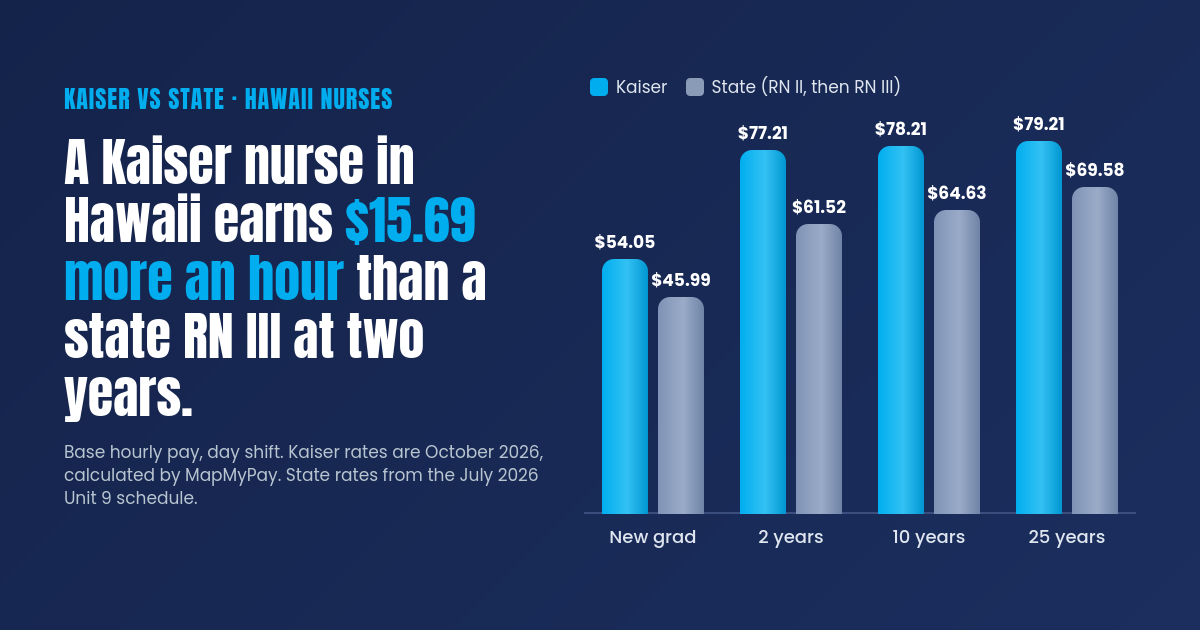
The usual line on public nursing jobs is that they pay less now and make it back later. In Hawaii, the first half of that holds up. A Kaiser nurse with two years of experience earns $77.21 an hour, while a state RN III with the same two years earns $61.52, or $15.69 an hour less.
On a 40-hour week, that comes to $32,641 a year. The state job can make some of that back, but only under two conditions. It depends on how long you stay and whether you ever hold an RN IV position, so the Kaiser vs state nurse comparison in Hawaii looks different from one nurse to the next.
Kaiser’s 2026 rates here are my calculation. I took the September 2024 contract rates and added the two 6.5% raises from the 2026 Kaiser national agreement, and Kaiser’s own Hawaii job postings list the same $54.05 starting rate. The state rates are printed on the July 1, 2026 Unit 9 salary schedule.
At a glance
| Kaiser (Oct. 2026, calculated) | State of Hawaii (July 2026) | |
|---|---|---|
| New grad hourly | $54.05 | RN II $45.99 |
| Hourly at 2 years | $77.21 | RN III $61.52 · RN IV $67.82 |
| Hourly at 25 years | $79.21 | RN III $69.58 · RN IV $76.75 |
| Night differential | $5.50 an hour | $4.00 an hour |
| Full-time week | 40 or 36 hours | 40 hours |
| Pension per year of service | 1.45% | 1.75%, nurse pays 8% of pay |
| Vacation, years 1 to 4 | 80 hours a year | 168 hours a year |
| Hospitals | Moanalua (Oahu) plus clinics | HHSC hospitals on Hawaii Island, Kauai, and Oahu |
Kaiser vs State Nurse Pay in Hawaii at Each Career Stage
The two scales hand out raises on different timelines. Kaiser puts its raises up front, moving a new nurse up every six months until the full job rate at 24 months. After that, the only step-ups are longevity pay of $1.00 an hour at 7 years and $2.00 at 15 years in the bargaining unit, on top of the raises every Kaiser nurse gets.
The state spreads its steps over a whole career. A state nurse moves up at 12, 18, and 24 months, then gets a longevity step every five years through year 25.
| Experience | Kaiser (calculated) | State RN III | State RN IV | Kaiser earns more than RN III |
|---|---|---|---|---|
| New grad | $54.05 · $112,424 | RN II $45.99 · $95,664 | Not open yet | $16,760 |
| 1 year | $57.91 · $120,453 | $56.90 · $118,344 | Not open yet | $2,109 |
| 2 years | $77.21 · $160,597 | $61.52 · $127,956 | $67.82 · $141,072 | $32,641 |
| 5 years | $77.21 · $160,597 | $63.05 · $131,136 | $69.53 · $144,624 | $29,461 |
| 10 years | $78.21 · $162,677 | $64.63 · $134,424 | $71.26 · $148,224 | $28,253 |
| 15 years | $79.21 · $164,757 | $66.24 · $137,772 | $73.05 · $151,944 | $26,985 |
| 25 years | $79.21 · $164,757 | $69.58 · $144,732 | $76.75 · $159,636 | $20,025 |
Hourly rate, then yearly pay at 40 hours a week. Kaiser yearly pay is the hourly rate times 2,080 hours. State yearly pay is the annual rate printed on the July 1, 2026 schedule. The state 1-year row assumes the position has moved from RN II to RN III. Kaiser’s 10-year and later rows include its longevity pay for years in the bargaining unit.
The two scales come closest around the one-year mark. If a state nurse’s position has moved up to RN III by then, the state pays $56.90 an hour against Kaiser’s $57.91, a difference of $1.01. Kaiser’s jump to the job rate at 24 months opens it back up to $15.69. The hourly lead is still $14.16 at five years and $13.58 at ten.
Against a state RN III, Kaiser still pays $9.63 an hour more at 25 years, or $20,025 a year. The lead falls to $2.46 an hour, or $5,121 a year, only when the state nurse holds an RN IV position.

Night pay and the raises both employers have already scheduled move the hourly numbers a little more.
Night shift pay
Both employers pay a flat dollar amount for nights. Kaiser adds $5.50 an hour and the state adds $4.00, so a full-time night nurse earns $3,120 more a year at Kaiser on top of the base difference. Because the amount never rises, a flat night differential becomes a smaller part of your pay every year the base rate climbs.
The 2028 schedules
The state has already printed its July 2028 schedule, where an RN III at two years earns $65.80. Kaiser’s national agreement adds 3% in August 2027, 2.5% in October 2027, and 3% in October 2028, which by my calculation brings its job rate to about $83.97. That would put Kaiser $18.17 an hour ahead at two years by late 2028.
How Each Job Moves You Up the Scale
A year of experience doesn’t count the same way on both scales, and that changes where an experienced nurse lands after a move.
Kaiser placement
Kaiser credits RN experience from the five years before you’re hired. For a hospital job, it counts acute care at 20 or more hours a week, and for a clinic job, it also counts clinic and physician office work. With two years of that experience, a new hire starts at the full job rate of $77.21. A nurse coming back after five to ten years away, with at least a year of experience, starts at the 7 to 12 month rate.
The longevity pay at 7 and 15 years counts only years in the Kaiser Hawaii bargaining unit, so mainland years don’t count toward it.
State steps
The state also counts RN experience from the last five years, but only toward steps C, D, and E, and only after three months on the job. The longevity steps, L1 through L5, count years as an RN with a Unit 9 employer. A nurse with ten years on the mainland would move up to step E, $61.52 as an RN III, after three months on the job.
RN III and RN IV
New grads start as RN II at $45.99 and stay there until their position is reallocated to RN III. RN IV pays $5.60 to $7.17 more an hour than RN III at every step, but it comes with a position, not with time. It needs at least 18 months of experience and a job classified at that level.
Sponsored · Map My Pay earns a commission if you use the SoFi link below.
Pay is only part of the picture for nurses who are still paying off school. Start with the free check: see if your hospital counts for Public Service Loan Forgiveness on studentaid.gov. Many nonprofit and public hospitals do, and refinancing federal loans into a private loan ends that option for good.
If PSLF is not your plan, or your loans are already private, Map My Pay partners with SoFi at Work. My wife and I have used SoFi ourselves. We cosigned our daughter's college loans with them and borrowed from them when we bought our house. Their rates were the best we found, and they are still some of the best I see. Our readers get member rate discounts on student loan refinancing, and checking your rate won't affect your credit score. Check your SoFi member rate →
Before accepting a state offer, it helps to know whether the job is posted as RN III or RN IV and whether the unit has RN IV positions at all. That one classification is worth up to $14,904 a year at the top step.
Kaiser vs State Nurse Benefits in Hawaii: Pension, Premiums, and Paid Leave
Benefits are where the state job makes up ground. Four of them come with numbers you can weigh against the pay difference.
Pension
Both employers offer a pension that pays a share of your pay for each year you work. The state’s ERS hybrid plan pays 1.75% for each year of service, times the average of your five highest-paid years. Kaiser’s contract sets a 1.45% multiplier and leaves the rest of the formula, including which pay it uses, to the plan document.
The state plan has a cost the Kaiser contract doesn’t mention. Every state nurse hired after June 30, 2012 is in the hybrid plan and pays 8% of base pay into it, and the pension vests after 10 years of service.
| 25 years, 2026 pay | Per year | Share of pay | Pension a year | Nurse pays in |
|---|---|---|---|---|
| Kaiser | 1.45% | 36.25% | $59,724 if based on final pay | None listed in the contract |
| State RN III | 1.75% | 43.75% | $63,320 | $11,579 a year at the top step |
| State RN IV | 1.75% | 43.75% | $69,841 | $12,771 a year at the top step |
Pension a year = multiplier times 25 years times the 2026 annual rate, with pay held flat. Kaiser’s plan document defines its pay base, so its figure is an estimate. Before taxes.
For a 25-year RN III, the state pension pays about $3,596 more a year than Kaiser’s would if Kaiser’s plan uses final pay. That nurse paid 8% of every check into the plan and earned $20,025 a year less than a Kaiser nurse at the top step. For a 25-year RN IV, the state pension pays about $10,117 more a year, which makes up much more of the difference.
Health premiums
State nurses get coverage through the state’s employee health fund, called EUTF. For the plan year that started July 1, 2026, a Unit 9 nurse on the Kaiser Standard HMO pays $60.66 a month for self coverage and $188.00 a month for a family. The state puts in a set dollar amount, so a richer plan costs the nurse more. Self coverage on the HMSA 80/20 PPO runs $275.18 a month before drug coverage.
Kaiser’s contract paid 100% of a single nurse’s premium and 90% for a family through 2025. Its 2026 and 2027 shares are set in the national agreement, and I couldn’t find them published.
Paid leave
State nurses earn 14 hours of vacation and 14 hours of sick leave every month, or 168 hours of each a year, from the start. Kaiser gives 80 hours of vacation a year for the first four years, 120 hours from four to seven years, and 160 hours after that. Its sick leave builds at 3.70 hours each pay period.
A new state nurse gets 88 more vacation hours a year than a new Kaiser nurse, about 11 more eight-hour days off with pay. By year seven, the vacation difference shrinks to 8 hours.
Retirement match
Kaiser matches 50% of what a nurse puts into its 403(b), on up to 2% of pay. At the two-year rate, the full match is worth about $1,606 a year. I found no employer match in the Unit 9 contract.
Kaiser vs State Nurse Take-Home in Honolulu, Hilo, and Kona
I ran both two-year paychecks through 2026 federal brackets and 2026 Hawaii brackets for a single filer taking the standard deduction. The state check also loses the 8% pension contribution, and Hawaii taxes that contribution even though the federal return doesn’t.
| Two years, 40 hours a week | Kaiser (calculated) | State RN III |
|---|---|---|
| Gross pay | $160,597 | $127,956 |
| Federal income tax | $27,277 | $17,068 |
| Social Security and Medicare | $12,286 | $9,789 |
| Hawaii income tax | $10,481 | $7,921 |
| Pension contribution (8%) | $0 | $10,236 |
| Take-home | $110,553 | $82,942 |
2026 tax year, single filer, standard deduction. The pension contribution is taken out before federal tax but not before Hawaii tax. Assumes both jobs pay Social Security and Medicare.
The Kaiser nurse takes home $27,611 more a year, or about $2,301 a month. About $10,236 of it is the state nurse’s pension contribution, which goes toward retirement instead of the paycheck.
The next table keeps each paycheck the same and changes only the city, so rent and the mortgage are the only numbers that move. Kaiser’s only hospital is on Oahu, so a Kaiser nurse living in Hilo or Kona would be working at one of its clinics.
| City | Rent a month | Kaiser keeps (renting) | State RN III keeps (renting) | Kaiser keeps (buying) | State RN III keeps (buying) |
|---|---|---|---|---|---|
| Honolulu, HI | $2,548 | $79,977 | $52,366 | $50,097 | $22,486 |
| Hilo, HI | $1,859 | $88,245 | $60,634 | $67,401 | $39,790 |
| Kailua-Kona, HI | $3,041 | $74,061 | $46,450 | $39,741 | $12,130 |
Kept = take-home minus a year of rent, or minus a year of the monthly mortgage on the median home at 7.065%. Median homes: $758,507 in Honolulu, $541,440 in Hilo, and $888,451 in Kailua-Kona. Rent and home data from Map My Pay city data.
The city doesn’t change the order. Rent in Kailua-Kona runs the highest of the three in our data. Even so, a Kaiser nurse renting there keeps $74,061 a year, or $13,427 more than a state RN III renting in Hilo.
Buying the median home in Kailua-Kona would leave a state RN III with $12,130 a year after the mortgage, against $39,741 for a Kaiser nurse.
Hospital and Clinic Jobs by Island
A higher scale doesn’t help a nurse whose island has no opening on it, and the two employers spread their jobs very differently.
The jobs sort out by employer and island like this.
Maui is a separate case. HHSC handed its three Maui hospitals to Maui Health, a Kaiser affiliate, in 2017, so those jobs don’t pay from the state schedule. Maui Health is its own employer, so its pay is worth checking before assuming it matches Kaiser’s.
For a nurse moving from the mainland, either job starts with a Hawaii license by endorsement.
Which Nurse Each Job Fits
The better job depends on how long you plan to stay and which island you want to live on.
The numbers point different nurses in different directions.
Part-time Kaiser nurses are a separate case. The contract gives part-timers under Section 3.5 no pension and half of the employer’s medical contribution, so the full-time numbers above don’t fit them.
The Choice Between Kaiser and the State
Kaiser pays more than the state at every stage of a Hawaii nursing career. Its lead is largest between two and ten years, when it runs close to $30,000 a year. The state job gives more paid leave and a bigger pension, partly paid for by the nurse, and it comes close on total value only for a nurse who stays about 25 years and holds an RN IV position. The choice comes down to how long you plan to stay and which island you want to work on.
This article is for general information and isn’t tax, legal, or financial advice. Kaiser’s 2026 rates are MapMyPay calculations, not a published Kaiser rate sheet, and differentials and longevity amounts are the last ones printed in the contract. Tax figures are estimates for a single filer with no other income. Check your own contract, rate sheet, and plan documents before making a job decision.