


Staff RN · Map My Pay Co-Founder · October 6, 2026
Kaiser Northwest nurses in Portland, OR, are due a 6.5% raise this month, on top of the 12.5% they ratified in March. The union's summary of the deal lists no change to the night differential, which was $5.90 an hour for the whole 2021 to 2025 contract. The raise lifts every step of the scale and leaves night pay where it was.
Logan Health nurses in Kalispell, MT, went the other way. The contract they ratified on September 11 raised pay for night shift, though the new amount isn't public yet. Their 2021 contract paid nights a flat $3.25 an hour.
Both stories turn on how a contract writes night pay. A flat night differential pays the same dollars at every step, and a percentage pays a share of your rate, so it grows every time your rate does. The two can look close in your first year and end up far apart. I covered what night shift differential pay adds over a career in August. The way the contract writes it decides how much of that you see.
| At a glance | How nights are paid |
| Providence Portland, flat $10 | 17.3% of new-grad pay, 11.8% at the top |
| Kaiser Northwest, flat $5.90 | 13.4% of Step 1 in 2021, 10.4% now |
| UC San Diego, flat $5 | 7.8% of new-grad pay, 5.4% at the top |
| UCSF, 16% | $14.24 for a new grad, $19.38 at the top |
| OHSU, 13% | Passes Providence's $10 at 15 years with a BSN |
| Same Providence scale, a percentage that starts at $10 | $157,098 more over 30 years |
A flat night differential is worth a little less every year you stay, because steps and raises lift your base pay while the flat amount stays the same until the next contract. A large flat amount can still beat a small percentage for years, so compare night offers at the step you would hold five years out. Some contracts sit between the two by raising the night rate on a set date, the way OHSU moved from 12.5% to 13% in July 2025. Check for a date next to the number.
Why a flat night differential shrinks as you climb the scale
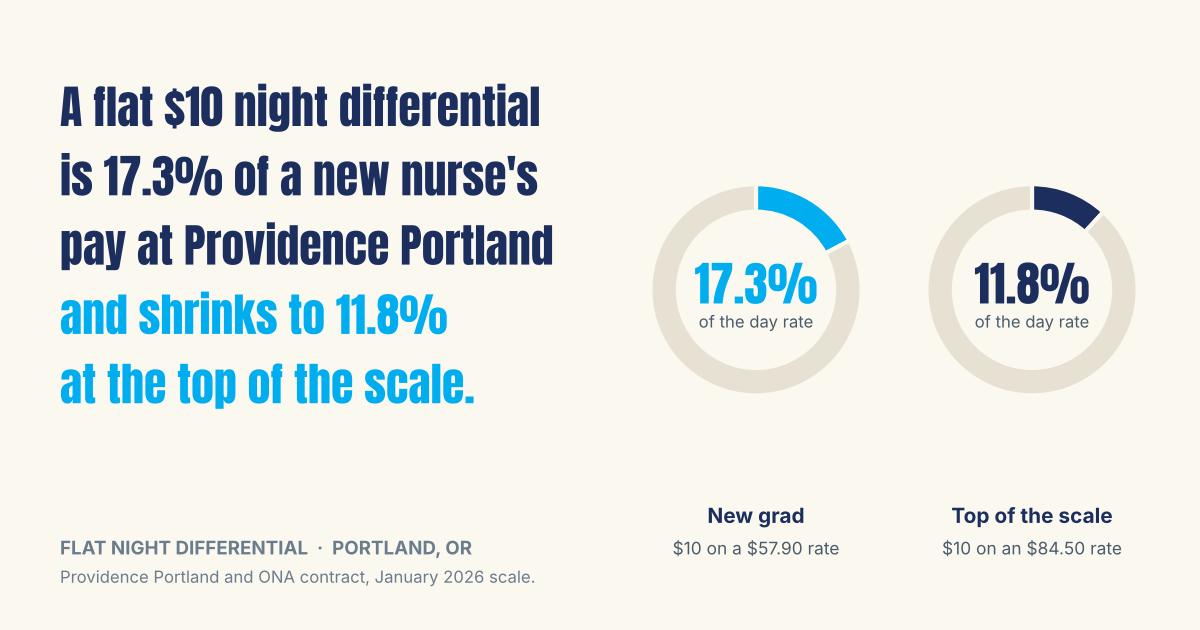
Your base rate goes up every time you move a step. A flat night differential doesn't move with it, so each step makes it a smaller part of what you earn on nights. The Providence Portland contract pays nights a flat $10 an hour at every step.
| Providence Portland | Day rate | Night pay | Share of the day rate |
| New grad | $57.90 | $10.00 | 17.3% |
| 5 years | $67.93 | $10.00 | 14.7% |
| 10 years | $71.57 | $10.00 | 14.0% |
| 20 years | $78.62 | $10.00 | 12.7% |
| Top of the scale, 30 years | $84.50 | $10.00 | 11.8% |
January 2026 scale. The contract counts a shift as a night shift when most of its scheduled hours fall between 11 p.m. and 7 a.m.
A $10 differential is a big one, and a new Providence nurse on nights earns $18,720 extra a year on three 12-hour shifts a week. A nurse at the top of the scale earns the same $18,720, even though her day rate is $26.60 an hour higher.
The same thing happens with a smaller flat amount. My UC San Diego guide found that nights there add a flat $5, which is 7.8% of a new grad's rate and 5.4% at the top of the scale.
Why raises skip a flat night differential
An across-the-board raise lifts every step of the scale by the same percentage. A flat night differential is written as a separate dollar amount, so the raise doesn't touch it, and it stays the same until a new contract changes it.
Kaiser Northwest shows how far that can go. Step 1 paid $44.03 in October 2021 under the 2021 to 2025 contract, and with this month's raise it reaches $56.54, which is 28.4% higher. That contract listed one night differential, $5.90, for its whole term, and the union's summary of the new deal lists no change. For a nurse at Step 1, $5.90 was 13.4% of the base rate in October 2021 and is 10.4% now.
Providence Portland's contract does the same thing on a schedule. It adds 4% to the scale in January 2027, which takes a new nurse to $60.22 and the top step to $87.88. The $10 for nights doesn't change, so its share drops to 16.6% for a new grad and 11.4% at the top.
Sponsored · Map My Pay earns a commission if you use the SoFi link below.
Pay is only part of the picture for nurses who are still paying off school. Start with the free check: see if your hospital counts for Public Service Loan Forgiveness on studentaid.gov. Many nonprofit and public hospitals do, and refinancing federal loans into a private loan ends that option for good.
If PSLF is not your plan, or your loans are already private, Map My Pay partners with SoFi at Work. My wife and I have used SoFi ourselves. We cosigned our daughter's college loans with them and borrowed from them when we bought our house. Their rates were the best we found, and they are still some of the best I see. Our readers get member rate discounts on student loan refinancing, and checking your rate won't affect your credit score. Check your SoFi member rate →
At Kaiser Northwest, base pay at Step 1 rose 28.4% from 2021 to this month, and the $5.90 night differential stayed the same the whole time.
Put your own day rate and night differential into the salary calculator to see the yearly pay after taxes.
Open the salary calculator →How a percentage night differential grows with you
A percentage is written as a share of your rate, so it climbs with every step and every raise without anyone bargaining for it again. Two hospitals show how much that adds.
UCSF's 16%
As I laid out in my UCSF hiring guide, nights there add 16% of the nurse's rate. That comes to $14.24 an hour for a new grad at $89.03 and $19.38 at the top step of $121.11. Over a year of three 12-hour night shifts, the differential grows from $26,657 to $36,279.
UCSF's contract adds 5% in January 2027. That raise lifts the top step to $127.17 and the night differential to $20.35. That is $1,816 more a year, with nothing new in the contract about nights. UCSF and UC San Diego nurses work under the same UC contract, and each campus writes its night pay its own way.
OHSU's 13%
The OHSU contract pays 13% of the nurse's rate for hours between 7 p.m. and 7 a.m., up from 12.5% before July 2025. A new grad with a BSN gets $7.52 an hour, and a nurse with a BSN at the top of the scale gets $11.45.
A large flat amount can still win for years. OHSU's 13% doesn't pass Providence's flat $10 until 15 years for a nurse with a BSN, or 20 years without one.
What a flat night differential costs over a career
Comparing two hospitals mixes up the way night pay is written with the size of each scale. To separate the two, I kept Providence Portland's own scale. Then I compared its flat $10 with a percentage set to pay the same $10 on day one, which works out to about 17.3%.
| Providence scale | Flat $10 | Percentage that starts at $10 | Extra a year |
| New grad | $10.00 | $10.00 | $0 |
| 5 years | $10.00 | $11.73 | $3,239 |
| 10 years | $10.00 | $12.36 | $4,418 |
| 20 years | $10.00 | $13.58 | $6,702 |
| 30 years | $10.00 | $14.59 | $8,592 |
Night pay per hour on Providence Portland's January 2026 scale. Extra a year assumes three 12-hour night shifts a week, or 1,872 hours.

The two start at the same $10, and the percentage pulls ahead with every step.
Over 30 years of nights, the percentage pays $718,698 and the flat $10 pays $561,600, which is $157,098 apart for the same nurse on the same scale. That uses today's scale with no future raises. The true difference would be larger, because each future raise would lift the percentage version again.
Night pay also feeds your nurse overtime rate, which is built on a regular rate that includes the differential. A percentage that grows each year lifts that rate too.

The flat differentials lose share between a new grad and a top-step nurse, while the percentages hold the same share.
Size still counts. Against OHSU's 13%, Providence's flat $10 pays $3,744 more over 30 years of nights at today's scales, because OHSU's 13% only passes $10 at year 15. That lead holds only at today's scales, because any raise to OHSU's base pay also raises its night pay.
How to compare night offers at your own step
A night offer looks like one number, and it only compares fairly once both offers are converted the same way. Four checks do that.
Say a five-year nurse with a BSN is weighing Providence Portland against OHSU. Providence pays $10 an hour on nights, or 14.7% of her $67.93 rate, and OHSU's 13% pays $9.15 on her $70.38 rate. Five years later, Providence still pays $10, now 14.0% of her rate, and OHSU pays $9.59.
See what the same night paycheck keeps after taxes and rent in the cities near the hospital you are weighing.
Compare cities →I am a staff RN, and I co-founded Map My Pay to show nurses what a job keeps after taxes and rent. The night pay rules here come from the signed Providence, OHSU, Kaiser Northwest, and Logan Health contracts and from the union's summary of the 2026 Kaiser deal. The UC rates come from my UCSF and UC San Diego guides, which project 2026 pay from UC's published 2025 tables and the contract raise.
A flat night differential is a fixed dollar amount in a contract where almost everything else grows, so it is worth a little less every year you stay. The fair way to compare night jobs is at the step you will hold five years from now.
Run your rate with nights added at today's step and five years out before you take a night job.
Run your rate →