


Staff RN · Map My Pay Co-Founder · October 1, 2026
When I wrote about getting a job at UCSF as a nurse last week, the part new grads messaged me about was the closed residency. A lot of you asked the same thing: if UCSF is not hiring new grads this year, where should you go so you can still get there? For most of you, the answer is another UC hospital, and the reason is written into the union contract.
Most new grads treat a job somewhere else as giving up on UCSF. The contract treats it the opposite way. A nurse working at any UC campus counts as an internal applicant for a UCSF posting. UCSF has to consider that nurse before it considers anyone from outside the system. A first job at another UC hospital is what qualifies you for the UCSF job you wanted.
One group sits between the two paths, and I want to name it before the table. If you already have a few months of paid RN work, you sit between the two paths. UC Davis will not take you, because its residency is only for nurses with no RN work at all. UCSF will not take you yet either, because a Clinical Nurse 2 job wants six months. Stanford and UC San Diego still accept you under six months. After that, your path is the staff postings, and the rest of this piece applies to you.
| At a glance | What it is |
|---|---|
| UCSF new grad residency | Not offered in 2026, no 2027 date posted |
| UCSF Clinical Nurse 2 requirement | California RN license and at least six months of clinical experience |
| UC Davis residency window | November 4 to 11, 2026, for March 15 and May 10, 2027 starts |
| UC San Diego residency window | October postings for the March 2027 cohort |
| Stanford residency | Cohort 46 application webinar October 7, 2026 |
| Kept after taxes and rent, UC Davis new grad | $69,898 a year in Sacramento, CA |
| Kept after taxes and rent, UCSF new grad | $64,680 a year in San Francisco, CA |
The UCSF new grad nurse residency is closed for 2026
I checked the UCSF Human Resources training page again on October 1. The notice from April is still up. The New Nurse Residency Training Program will not be offered in 2026, and the page asks you to check back for updates. It also says plainly that the residency is the only pathway for new graduate RNs to join the organization. There is no second new grad door, and no date for when this one reopens.
The eligibility rules are still posted, and they matter for planning. When the program runs, you need less than six months of RN employment at the start date. Your nursing degree has to be less than 18 months old. You need an active California RN license four weeks before the start. You are hired as a Clinical Nurse 1, and UCSF expects a two-year commitment to the hiring unit after training ends. UCSF's Career Development Training Program, which moves current UCSF nurses into new specialties, is paused for 2026 as well.
The 18-month degree window is the part that worries new grads most, and it should. If you graduate in December 2026 and UCSF announces a 2027 cohort, you are still inside the window. If the program stays closed into 2028, you are not. The degree window keeps running whether you have a job or not. That is why waiting without working can close both doors at once.
This is also a tight year to be a new nurse. Health care hiring was down about 12.1% from a year earlier in September, according to LinkedIn data reported by Becker's. The residencies that still run fill fast, and the windows are short.
Six months opens the other UCSF new grad nurse door
UCSF hires experienced nurses through regular unit postings. Most of those postings are for Clinical Nurse 2. The UC and California Nurses Association contract defines that job in Article 2. You need a California RN license and at least six months of clinical experience. That is the whole requirement. A new grad who works six months anywhere as an RN meets it.
Sponsored · Map My Pay earns a commission if you use the SoFi link below.
Most new grads reading this are only a few months from their first student loan bill. Start with the free check: see if your hospital counts for Public Service Loan Forgiveness on studentaid.gov. Many nonprofit and public hospitals do, and refinancing federal loans into a private loan ends that option for good.
If PSLF is not your plan, or your loans are already private, Map My Pay partners with SoFi at Work. My wife and I have used SoFi ourselves. We cosigned our daughter's college loans with them and borrowed from them when we bought our house. Their rates were the best we found, and they are still some of the best I see. Our readers get member rate discounts on student loan refinancing, and checking your rate won't affect your credit score. Check your SoFi member rate →
The same six months closes the residency doors. UCSF's own program caps you at less than six months of RN work. Stanford's residency caps you at six months of full-time paid RN work, which it counts as 1,040 hours. You also must have graduated within 19 months of the cohort start. UC San Diego's program is for newly licensed RNs with less than six months of nursing experience. UC Davis is stricter than all three. Its residency has to be your first paid RN position. The FAQ says you are not eligible if you have ever worked as an RN.
So the clock runs the same way for everyone. Before six months, you are a residency candidate at Stanford, UC San Diego, and a reopened UCSF. You are a residency candidate at UC Davis only if the job is your first. After six months, you are a Clinical Nurse 2 candidate at UCSF and every other UC hospital. Every new grad crosses that line in the first year. The open decision is which hospital you are standing in when you do.
See what a nurse keeps in Sacramento, San Francisco, San Diego, and Palo Alto after taxes and rent. The city browser runs the same math for 21,000 cities.
Compare cities →The best places to spend those six months
Not every first job does the same work for you. Article 13 of the UC contract sets the order UCSF has to follow when it fills a vacancy. Recalled laid-off nurses come first. Nurses on the preferential rehire list come second. The most senior qualified internal applicant from the same UC location comes third. The most senior qualified internal applicant from a different UC location comes fourth. Any other qualified applicant comes last. A new grad at UC Davis or UC San Diego lands in that fourth group. A new grad at Stanford, Sutter, or Kaiser lands in the fifth. I ranked the options on that order first, then on training, then on what you keep.
Another UC Hospital
UC Davis Health takes residency applications November 4 to 11, 2026, for Cohort 60 starting March 15, 2027, and Cohort 61 starting May 10, 2027. The posting is live for one week only. You need a California license by the start date, and the program asks for a one-year commitment. The pay is lower than UCSF, about $73.72 an hour for a new grad on days against UCSF's $89.03. Sacramento rent is lower by more than that pay gap, which the next section shows.
UC San Diego Health posts its new grad jobs in October for the March 2027 cohort. An applicant webinar runs about a week before the posting. I walked through the whole process in the piece on how new grads get hired at UC San Diego Health, so I will not repeat it here. The hiring-order edge is the same as UC Davis. The money is not, because San Diego rent eats most of the lower pay.
Stanford and Other Bay Area Residencies
Stanford's Cohort 46 application webinar is October 7, 2026. The program wants ACLS as well as BLS at hire, and a full California license rather than an interim permit. It pays the most of the four, about $92.77 an hour for a new grad. The training is as strong as any in the state. The catch for a UCSF plan is that Stanford is a separate employer under a separate union. A Stanford nurse applies to UCSF as an outside candidate. If UCSF is the goal, Stanford is the best non-UC start, and I covered its scale in the guide to getting hired at Stanford as a nurse.
An East Bay Acute Care Job
A med-surg or telemetry job at an East Bay hospital keeps you within commuting distance of UCSF's campuses. That matters for a second route in. UCSF hires per diem nurses at the Clinical Nurse 2 level. A per diem nurse who works 60 shifts in six months gets credit toward probation when a career job opens in the same area. An East Bay nurse can add UCSF per diem shifts after the first year and become an internal UCSF applicant that way. It is a longer road than the UC route, with no contract preference at the start, but it keeps you close.
A Clinic Job
A clinic or outpatient job counts toward the six months, since the contract says clinical experience and nothing more. In practice, UCSF's inpatient Clinical Nurse 2 postings list recent acute care experience among their preferred qualifications. A manager choosing between two six-month nurses will take the one who has run a four-patient assignment. Take a clinic job if it is the only offer, and keep applying to acute care while you hold it.
Run your own offer. Put a hospital's hourly rate into the salary calculator and see what it leaves after taxes and the rent in that city.
Open the calculator →What each starting hospital leaves after rent
You would expect the hospital with the highest hourly rate to leave the most money at the end of the year. For a new grad, it does not. I took the 2026 new grad day rate at each of the four hospitals and ran it at three 12-hour shifts a week, which is 1,872 hours a year. Then I pulled the tax and median rent for each hospital's city from our database. A UCSF new grad nurse earns $28,660 more than the UC Davis new grad before taxes, and $16,682 more after taxes. San Francisco rent then costs $21,900 more a year than Sacramento rent, and the order flips.
| Starting hospital | Day rate | Yearly pay | After tax | Rent a month | Kept after rent |
|---|---|---|---|---|---|
| UC Davis, Sacramento, CA | $73.72 | $138,004 | $93,958 | $2,005 | $69,898 |
| Stanford, Palo Alto, CA | $92.77 | $173,665 | $115,008 | $3,865 | $68,628 |
| UCSF, San Francisco, CA | $89.03 | $166,664 | $110,640 | $3,830 | $64,680 |
| UC San Diego, San Diego, CA | $63.77 | $119,377 | $83,125 | $2,893 | $48,409 |
Day rate is the 2026 new grad base rate on the UC wage tables and the Stanford nurses' union scale, with no shift or certification differentials. Yearly pay is the rate times 1,872 hours. After tax is a single filer with the standard deduction, federal and California income tax, Social Security, Medicare, and California disability insurance, with no retirement or health deductions. Rent is the median monthly rent in each city from the Map My Pay database, May 2026 export. Kept after rent is after tax minus twelve months of rent.
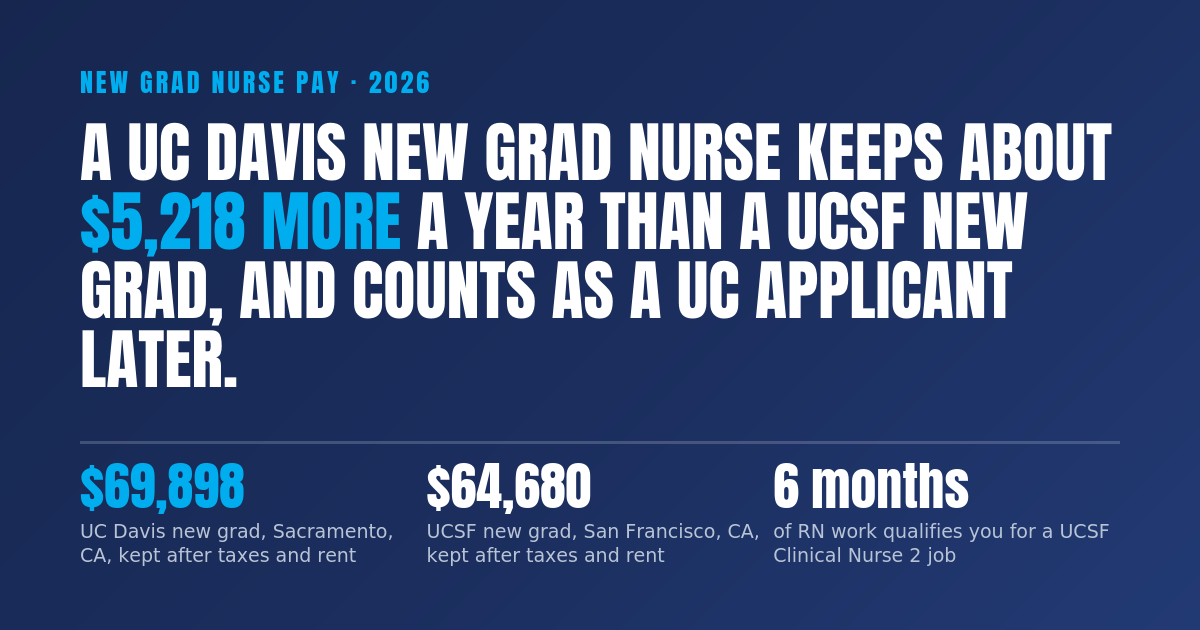
The UC Davis new grad keeps $69,898, or about $5,825 a month after rent is paid. The UCSF new grad keeps $64,680, or about $5,390 a month. That is a $5,218 difference in favor of the lower-paid job, and it comes entirely from rent. Stanford lands between them at $68,628. That is close to the UC Davis number, but without the UC hiring preference. UC San Diego keeps the least at $48,409. Its new grad rate is the lowest of the four, and San Diego rent is not far below San Francisco's.
The gap grows if you price San Francisco at what listings show now. Our May export puts San Francisco median rent at $3,830. Our newer data puts it at $4,538. At that rent, a UCSF new grad would keep about $56,184, and the difference against UC Davis grows to $13,714 for the same six months of experience. The UC hospital pay comparison I ran in July showed the same thing. Rent, not the hourly rate, decides which UC campus leaves the most.
When a UCSF new grad nurse should apply
Six months is the minimum for the Clinical Nurse 2 classification. It is not a promise that you can walk out of a residency at month six without cost. UC Davis asks for a one-year commitment to its program. UC San Diego runs its core residency classes over six months, with at least three months of precepted orientation. UCSF's own residency, when it runs, asks for two years on the hiring unit. None of those programs publish a repayment penalty on their public pages. The UC contract does not stop a nurse from applying to another campus during a program. Even so, a manager at UCSF will see the start date on your application. A nurse who finished the year will interview better than one who is leaving at month seven.
My read is to treat the first UC year as the plan, and the six-month mark as the point where you start watching UCSF postings. Apply to the ones that fit your unit experience as they open. If you get an offer before the year is up, you decide then with the offer in hand. The hiring order in Article 13 works for you the whole time. It is tied to where you work, not how long you have worked there.
Per diem is the second route, and it works from any starting hospital in the Bay Area. UCSF per diem nurses are classified at the Clinical Nurse 2 level, so the same six months qualifies you. Once you are on UCSF's per diem roster, you are a UCSF internal applicant for career postings. Sixty shifts in six months also earns you three months of probation credit when you convert. If your first job is at UC Davis, the per diem route is a long drive. If it is in Oakland or Walnut Creek, it is the natural second step.
Compare Sacramento against the East Bay before you pick a first job. The city browser shows what the same paycheck leaves after rent in Oakland, Walnut Creek, Concord, and Sacramento.
Open the city browser →UCSF will reopen its residency at some point. When it does, the new grads who waited at home will compete for a handful of seats against people who did not wait. The ones who spent the year at UC Davis or UC San Diego will not need those seats. They will already be UC nurses with a year of acute care behind them, applying to Clinical Nurse 2 postings ahead of every outside candidate. The ones in Sacramento will have done it with more money in the bank than a UCSF new grad would have. That is the version of waiting I would pick.
Before you accept a first offer, run the rate through the calculator and see what it leaves after taxes and rent in that city.
Run your offer →Sources
This article is for general information and reflects program pages and contract language as of October 1, 2026. Residency windows, eligibility rules, and wage tables change. Confirm dates on each hospital's own page before applying. Tax figures assume a single filer taking the standard deduction with no pre-tax deductions, and rent figures are city medians, not quotes for a specific unit. Map My Pay is not a financial, tax, or legal advisor.