

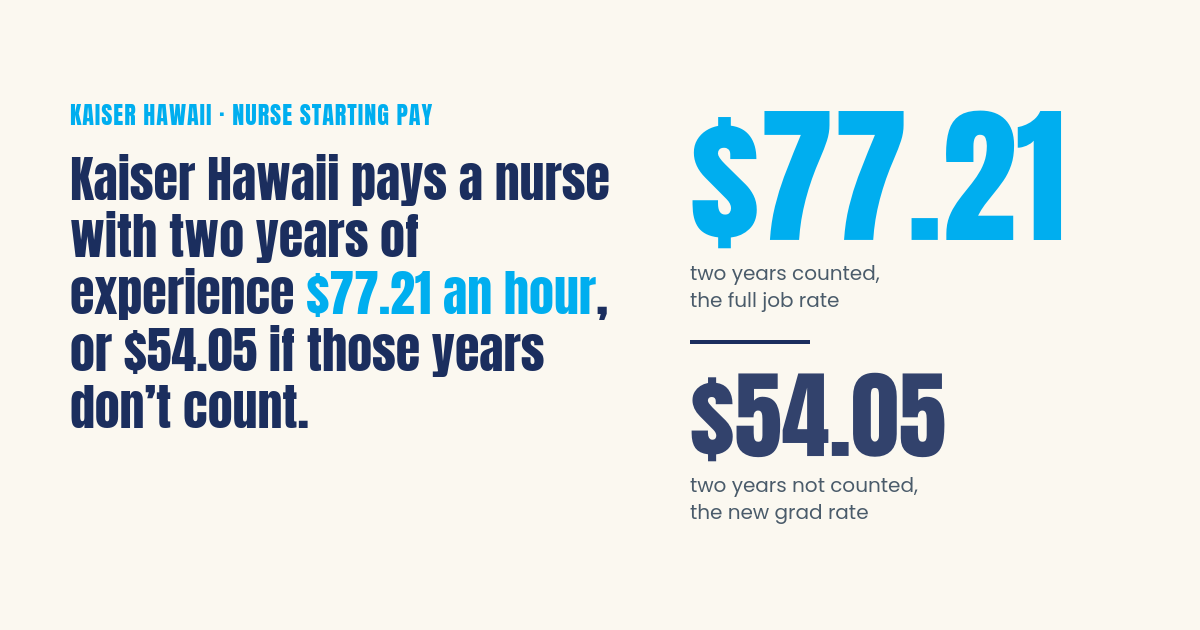
Two nurses with the same years can start $23.16 an hour apart at Kaiser Hawaii. Kaiser Hawaii nurse starting pay comes from a formula written into the union contract. Kaiser counts your RN experience from the last five years and places you on one of five steps. I read the placement rules line by line so you can see where you would land before you apply.

Staff RN · Map My Pay Co-Founder · October 2026
Picture two nurses applying to the same Kaiser unit in Honolulu. Each has two years at the bedside. One worked full time and starts at $77.21 an hour, Kaiser’s full job rate. The other spent those two years as a per diem nurse averaging 16 hours a week. That falls under the contract’s 20-hour line, so she starts at $54.05, the new grad rate.
Neither rate came out of a negotiation. The contract between Kaiser and Hawaii Nurses and Healthcare Professionals, the roughly 1,500-member union for Kaiser’s Hawaii nurses, places every new hire with a written formula. Kaiser Hawaii nurse starting pay depends on the experience you can prove under that formula. Not the experience you have. The experience you can prove.
Kaiser’s 2026 rates in this piece are my calculation. I took the September 2024 contract rates and added the two 6.5% raises from the 2026 Kaiser national agreement. Kaiser’s Hawaii job postings list the same $54.05 starting rate, which is a good sign the math holds.
At a glance
| Kaiser Hawaii staff RN placement | |
|---|---|
| Starting steps | Five, from $54.05 to $77.21 an hour (October 2026, calculated) |
| Experience window | The five years before your hire date |
| Hours test | 20 or more hours a week of direct patient care |
| What counts | Acute care (including surgical centers, birthing centers, and ERs), clinics, and physician offices |
| New grad to job rate | About 24 months |
| Biggest single raise | $11.58 an hour, at the job rate |
| Probation | 90 days, or 120 days under six months of experience or part time |
| Fixing a wrong step | Grievance; arbitration back pay capped at 60 days before filing |
Kaiser Hawaii Nurse Starting Pay at Each of the Five Steps
Kaiser’s scale has four start steps below the full job rate. Each one pays a set share of the job rate, from 70% to 85%. A nurse moves up one step about every six months until she reaches the job rate at 24 months.
| Step | Credited experience | Hourly (calculated) | Three 12s a week | 40 hours a week |
|---|---|---|---|---|
| New grad step | 0 to 6 months | $54.05 | $101,182 | $112,424 |
| Second step | 7 to 12 months | $57.91 | $108,408 | $120,453 |
| Third step | 13 to 18 months | $61.77 | $115,633 | $128,482 |
| Fourth step | 19 to 23 months | $65.63 | $122,859 | $136,510 |
| Job rate | 24 months and up | $77.21 | $144,537 | $160,597 |
Yearly pay = hourly rate times 1,872 hours (three 12-hour shifts a week) or 2,080 hours (40 hours a week). Kaiser counts both 36 and 40 hours a week as full time. October 2026 rates, calculated by MapMyPay.
The last move is the big one. Going from the fourth step to the job rate adds $11.58 an hour. That is a 17.6% raise, and as much as the first three moves put together.

Kaiser also places you at the right month inside a step. A nurse with 15 months of credited experience starts partway through the 13 to 18 month step, so her next raise comes in a few months instead of six. A nurse with 18 months goes straight to the fourth step at $65.63, about six months from the job rate.
What Experience Counts Toward Kaiser Hawaii Starting Pay
Kaiser credits experience that passes three tests. It has to be direct patient care. It has to be 20 or more hours a week. And it has to fall inside the five years before your hire date.
Acute care
Hospital work counts in full at 20 or more hours a week. The contract also treats free-standing surgical centers, birthing centers, and emergency rooms as acute care. In-service instructors at acute care hospitals get full credit too.
Clinic and physician office work
Direct patient care in a clinic counts at 20 or more hours a week, and so does work in a physician’s office. One catch: the contract lists this credit under its clinic nurse heading. Ask HR whether it applies when the job you want is on a hospital unit.
Rehab and skilled nursing
Two narrower rules cover post-acute care. Time at the Rehabilitation Hospital of the Pacific counts toward placement. Time at a skilled nursing or intermediate care facility counts only when you apply to a Kaiser skilled nursing unit.
The five-year window
Only experience from the five years before your hire date counts. Say a nurse worked eight years and then stepped away for four. She gets credit for the one year inside the window, which places her at the third step, $61.77. The other seven years are gone.
Hours under 20 a week
The contract gives no partial credit below the 20-hour line. On its plain reading, a per diem or part-time history that averaged under 20 hours a week doesn’t count toward your step, however many years it covers.
Travel and agency work isn’t excluded. A full-time travel contract in a hospital counts like any other acute care job, as long as you can show the dates and weekly hours.
Special Cases With Their Own Placement Rules
Five groups of nurses don’t follow the standard count. Each rule can move a starting rate by thousands of dollars a year.
A break of five to ten years
This rule covers a nurse who has been out of nursing for more than five years but no more than ten, with at least a year of qualifying experience. That nurse starts at the second step, $57.91 an hour, even though the experience falls outside the five-year window.
A return to Kaiser
A nurse who worked at least one year as a regular Kaiser Hawaii employee and comes back within three years gets the job rate, $77.21, once orientation ends. To qualify, the nurse also needs at least 23 months of acute care experience in the five years before rehire.
A move from Queen’s, Kapiolani, or Kuakini
Nurses hired from these Honolulu hospitals are counted by quarters instead of by weekly hours. Every quarter with 260 or more paid hours counts. The quarters don’t have to be back to back, and only quarters from the last five years count.
That works out to about 20 hours a week. The difference is that a slow quarter simply drops out without pulling the others down.
A Kaiser employee moving into an RN job
A Kaiser employee who has worked continuously in another job and becomes an RN keeps the old wage if it pays more than the RN start step. The protected wage holds until the RN scale passes it. It never goes above the RN job rate.
Nurse practitioners
Kaiser’s NP scale has its own entry rule. An NP with experience starts at the three-month rate of $86.70 and moves to the job rate of $88.92 after a three-month probation. An NP without experience starts at $84.48 and waits six months for the job rate.
What Uncounted Experience Costs
Missing credit doesn’t last forever, because every nurse reaches the job rate in the end. What it costs is the gap between the two paths until the lower one catches up. That adds up fast when a full step or more goes uncounted.
| Experience not counted | Correct starting step | Hourly difference at hire | Lost before job rate, three 12s | Lost before job rate, 40 hours |
|---|---|---|---|---|
| 12 months | 13 to 18 months ($61.77) | $7.72 | $39,743 | $44,158 |
| 18 months | 19 to 23 months ($65.63) | $11.58 | $54,194 | $60,216 |
| 24 months or more | Job rate ($77.21) | $23.16 | $65,033 | $72,259 |
Each row compares a nurse placed at the new grad step with the same nurse placed correctly, over the 24 months it takes the lower path to reach the job rate. Assumes six months per start step and 156 hours a month on three 12s, or about 173 on 40 hours. Before taxes. If the last start step runs five months instead of six, each total drops by roughly $1,800 to $2,000.
Sponsored · Map My Pay earns a commission if you use the SoFi link below.
Pay is only part of the picture for nurses who are still paying off school. Start with the free check: see if your hospital counts for Public Service Loan Forgiveness on studentaid.gov. Many nonprofit and public hospitals do, and refinancing federal loans into a private loan ends that option for good.
If PSLF is not your plan, or your loans are already private, Map My Pay partners with SoFi at Work. My wife and I have used SoFi ourselves. We cosigned our daughter's college loans with them and borrowed from them when we bought our house. Their rates were the best we found, and they are still some of the best I see. Our readers get member rate discounts on student loan refinancing, and checking your rate won't affect your credit score. Check your SoFi member rate →
For the per diem nurse in the opening example, that comes to about $65,033 before taxes on three 12-hour shifts. She spends two years climbing back to a rate the full-time nurse started at.
Even a smaller miss adds up. Twelve months that don’t get counted cost about $39,743 on three 12s. That is about $1,656 a month, for two years.
How to Document Your Experience Before You Apply
Kaiser can only credit the experience you can show. Gather the paperwork before the offer stage, not after.
Four records cover most of it.
Mainland nurses also need a Hawaii license by endorsement before they can start work. The license and the letters can run at the same time.
What to Check on the Offer Letter
Ask Kaiser to put your step in writing with the offer. Checking it against your own count belongs at the top of any list of job offer questions.
Four details are worth comparing with your records.
If something looks wrong, take it to Kaiser HR and your HNHP representative before you sign, or as soon as a paycheck shows it.
Fixing a wrong step
Placement falls under the contract, so a wrong step can go through the grievance procedure. The contract gives 14 calendar days to file from the union’s receipt of a breach. If the case reaches arbitration, back pay can’t reach more than 60 days before the filing date.
An error found a year after hire gets corrected from that point on, with no more than 60 days of back pay. That makes checking your first paycheck against the contract worth the half hour it takes.
Probation runs 90 days, or 120 days for nurses with under six months of experience and for part-timers. During probation, Kaiser can end a nurse’s job without a grievance. That limit covers termination, not pay.
Kaiser Hawaii Nurse Starting Pay Beyond This Contract
This contract runs through August 31, 2027. A 2020 letter inside it commits Kaiser and the union to review how new grads are placed in the wage structure, so the placement rules could look different after the next round of bargaining.
The records that protect your starting pay hold up under any contract. Each job’s dates and weekly hours, kept in writing as you go, become the proof that sets your rate at the next union hospital, in Hawaii or anywhere else.
This article is for general information and isn’t legal or financial advice. Kaiser’s 2026 rates are MapMyPay calculations, not a published Kaiser rate sheet. Placement decisions rest with Kaiser under the contract, and HNHP can confirm how a rule applies to you. Cost figures are before taxes and assume six months per start step.