

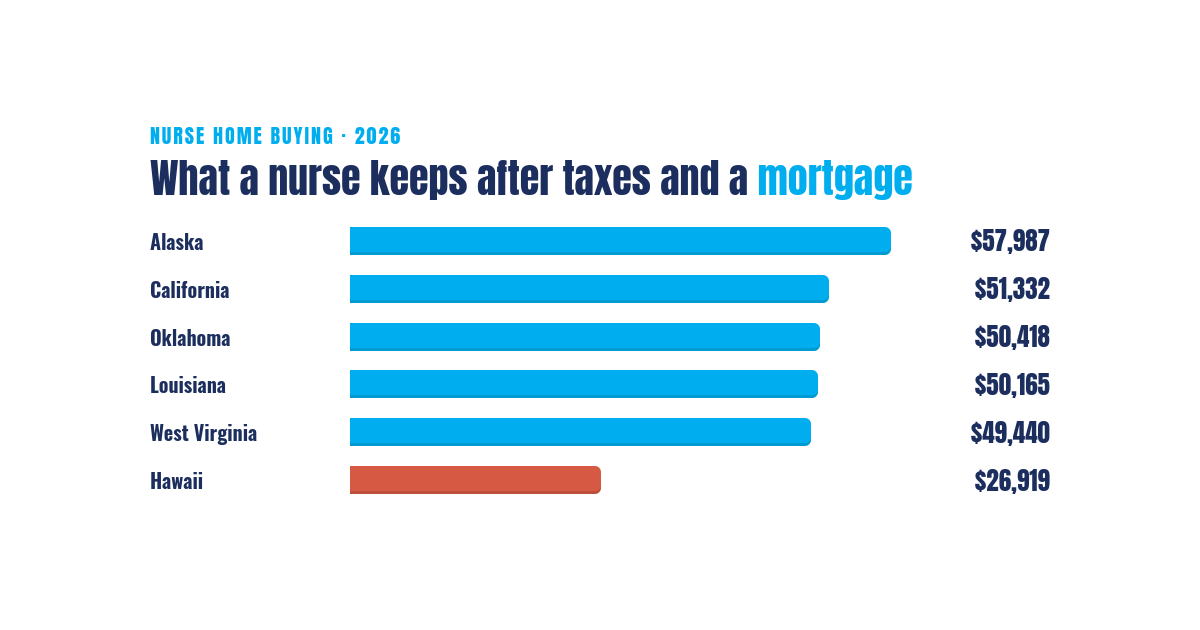
If you are a nurse trying to figure out the best states for nurses to buy a home, the answer is probably not the state you would guess. The place where you keep the most money as a renter is often a bad place to buy, and some quiet, cheap-home states turn out to be the best places in the country to own on one nursing paycheck.

Staff RN · Map My Pay Co-Founder · October 3, 2026
Most nurses pick where to live by two numbers: the pay and the rent. That makes sense when you are renting. But the day you start thinking about buying a home, the math flips, and the states that looked best suddenly are not.
I pulled the best states for nurses to buy a home from our city database and lined them up against the best states to rent in. They are two different maps. A median home price changes the whole picture, because your mortgage, not your rent, is now the biggest bite out of your check.
So I ranked every state by what a typical registered nurse keeps after income taxes and a mortgage on the median home. I am showing the full chain so you can follow the money: gross pay, income taxes, net take-home after taxes, the yearly mortgage, and what is finally left. Here is what showed up, and why it surprised me.
| At a glance | |
| Best state to buy on an RN paycheck | Alaska, keeps $57,987/yr |
| Biggest climbers from rent to buy | Kentucky 45th to 9th, West Virginia 42nd to 7th |
| Biggest drop from rent to buy | Hawaii, 5th to 48th |
| Why cheap-home states win | Small mortgage, more kept |
| What a U.S. nurse earns (median) | About $93,600/yr |
The buy map is not the rent map
When a nurse keeps the most money as a renter, it is usually because the pay is high. California, Alaska, Washington, and Oregon sit at the top of the rent list for that reason. The paycheck is big and the rent, while not cheap, does not eat all of it.
Buying changes the rule. A mortgage is tied to the home price, not the paycheck, so a state with expensive homes punishes a buyer even when the pay is strong. Oregon is a good example. It is the fourth best state to rent in, but once you price in a median home near $441,713, it slides to 18th for buyers.
That is why the two lists barely overlap. The states where you keep the most after rent are the high-pay coasts. The states where you keep the most after a mortgage are the places where a nurse can actually afford the house in the first place.
The 10 best states for nurses to buy a home
This table ranks states by what a typical RN keeps after income taxes and a mortgage on the median home. Follow it left to right: gross pay, income taxes, your net take-home after taxes, the yearly mortgage, and what is finally left to keep.
Sponsored · Map My Pay earns a commission if you use the SoFi link below.
Take-home pay only tells part of the story if some of every check goes to student loans. Start with the free check: see if your hospital counts for Public Service Loan Forgiveness on studentaid.gov. Many nonprofit and public hospitals do, and refinancing federal loans into a private loan ends that option for good.
If PSLF is not your plan, or your loans are already private, Map My Pay partners with SoFi at Work. My wife and I have used SoFi ourselves. We cosigned our daughter's college loans with them and borrowed from them when we bought our house. Their rates were the best we found, and they are still some of the best I see. Our readers get member rate discounts on student loan refinancing, and checking your rate won't affect your credit score. Check your SoFi member rate →
| State | Gross | Taxes | Net take-home | Mortgage/yr | Keeps/yr |
| 1. Alaska | $112,040 | $25,061 | $86,979 | $28,992 | $57,987 |
| 2. California | $148,330 | $48,368 | $99,962 | $48,630 | $51,332 |
| 3. Oklahoma | $85,880 | $21,410 | $64,470 | $14,052 | $50,418 |
| 4. Louisiana | $84,110 | $19,773 | $64,337 | $14,172 | $50,165 |
| 5. Illinois | $91,130 | $23,372 | $67,758 | $18,240 | $49,518 |
| 6. New York | $110,490 | $31,717 | $78,773 | $29,292 | $49,481 |
| 7. West Virginia | $80,820 | $19,932 | $60,888 | $11,448 | $49,440 |
| 8. Mississippi | $81,325 | $20,020 | $61,305 | $12,318 | $48,987 |
| 9. Kentucky | $83,900 | $20,912 | $62,988 | $14,112 | $48,876 |
| 10. Nevada | $102,400 | $22,203 | $80,197 | $31,392 | $48,805 |
Gross minus taxes equals net take-home. Net take-home minus the mortgage equals keeps. State figures are the median across each state's cities with RN pay data. The mortgage figure is the app's monthly housing payment at a 7.065% rate and already includes property tax (not insurance, HOA, or upkeep). Your own city can land well above or below the state median, so always check your exact town. The New York row is a good example: statewide the mortgage and property tax runs about $29,292 a year, but in New York City itself it is closer to $6,352 a month, and a nurse there keeps only around $111 a month after mortgage and tax, before insurance, upkeep, or HOA.
Look at the gross-pay column and the keeps column side by side. California pays almost double what West Virginia pays, yet a nurse keeps within about $1,900 of the same amount after buying. That is the home price doing the work. A West Virginia nurse spends about $11,448 a year on a mortgage, while a California nurse spends about $48,630, and that gap wipes out most of the pay advantage.
Who moves up and who falls when you buy
The clearest way to understand this is to watch which states climb and which ones fall when you switch from renting to buying.
The climbers are the cheap-home states. Kentucky jumps from 45th for renters to 9th for buyers. West Virginia goes from 42nd to 7th. Mississippi moves from 36th to 8th, and Louisiana from 27th all the way to 4th. None of these states pay nurses especially well. They win on buying because the house is cheap, so the mortgage leaves most of the check alone.
The fallers are the expensive-home states that renters love. Hawaii keeps the fifth most for renters but drops to 48th for buyers, because a median home there runs past $840,000 and the mortgage costs about $66,960 a year. Oregon falls from 4th to 18th, New Jersey from 15th to 47th, and Washington from 3rd to 11th. In each case the rent was manageable, but the home price is not.
| State | Rent rank | Buy rank | Median home |
| Kentucky | 45th | 9th | $165,557 |
| West Virginia | 42nd | 7th | $138,853 |
| Louisiana | 27th | 4th | $172,632 |
| Oregon | 4th | 18th | $441,713 |
| Hawaii | 5th | 48th | $840,050 |
Green rows are states that climb when you buy. Red rows are states that fall. Rankings cover the states with enough city-level RN data to compare.
What else comes out of your check each month
One warning before you fall in love with a keep number. The mortgage figure in these tables is the housing payment from the Map My Pay app, and it already folds in property tax. What it does not include is homeowners insurance, upkeep, or any HOA fees, and those are serious money every month.
So on top of that payment, plan for three more costs. Homeowners insurance commonly runs about $1,500 to $3,500 a year, or around $125 to $290 a month. A long-used rule of thumb is to set aside about one percent of the home's value a year for upkeep, which is another $200 or so a month on a $255,000 home. And if the home has an HOA, add that too. In much of the country it is small or even zero, but in a condo-heavy city like New York it can run well over $1,000 a month. These are estimates, not your exact bill, so treat them as a planning range.
Then there is the rest of life. Food, utilities, a car, gas, and insurance for a single adult commonly run somewhere around $1,650 a month, and more if you have kids. So the keep number in the table is what is left after taxes, the mortgage, and property tax, but a good chunk of it is already spoken for before you spend a dollar on yourself.
Take the Texas example below. The $2,015 a month already covers the mortgage and property tax. Add homeowners insurance and upkeep, about $480 a month here, and the house runs closer to $2,500 a month. After that and everyday living costs, a single Texas nurse is left with roughly $1,910 a month to save, invest, or spend, and that is before any HOA. That is still solid, and it is a far cry from the gross paycheck.
How to use this before you move
A state ranking is a starting point, not an answer, because home prices swing hard inside a state. California makes the buy list on its statewide median, but the Bay Area is a different world from Fresno or Bakersfield. The same is true in Texas, where Austin and a small town north of Dallas are not close.
So before you plan a move, do three things. Check the median home price in the exact town, not the state. Run the mortgage against your actual nursing pay for that town, and add insurance, upkeep, and any HOA on top, since property tax is already inside the mortgage figure. And compare what is left to where you live now, so you know if the move is actually worth it. If you are earlier in this, our breakdown of the best cities for nurses in 2026 and the cities where nurses keep the least are good next reads.
If you have been told to chase the biggest paycheck, buying a home is where that advice falls apart. The nurse who keeps the most is not the one with the highest salary. It is the one who bought a house they could actually afford, in a state where the mortgage and everything that rides along with it still left room to live.