
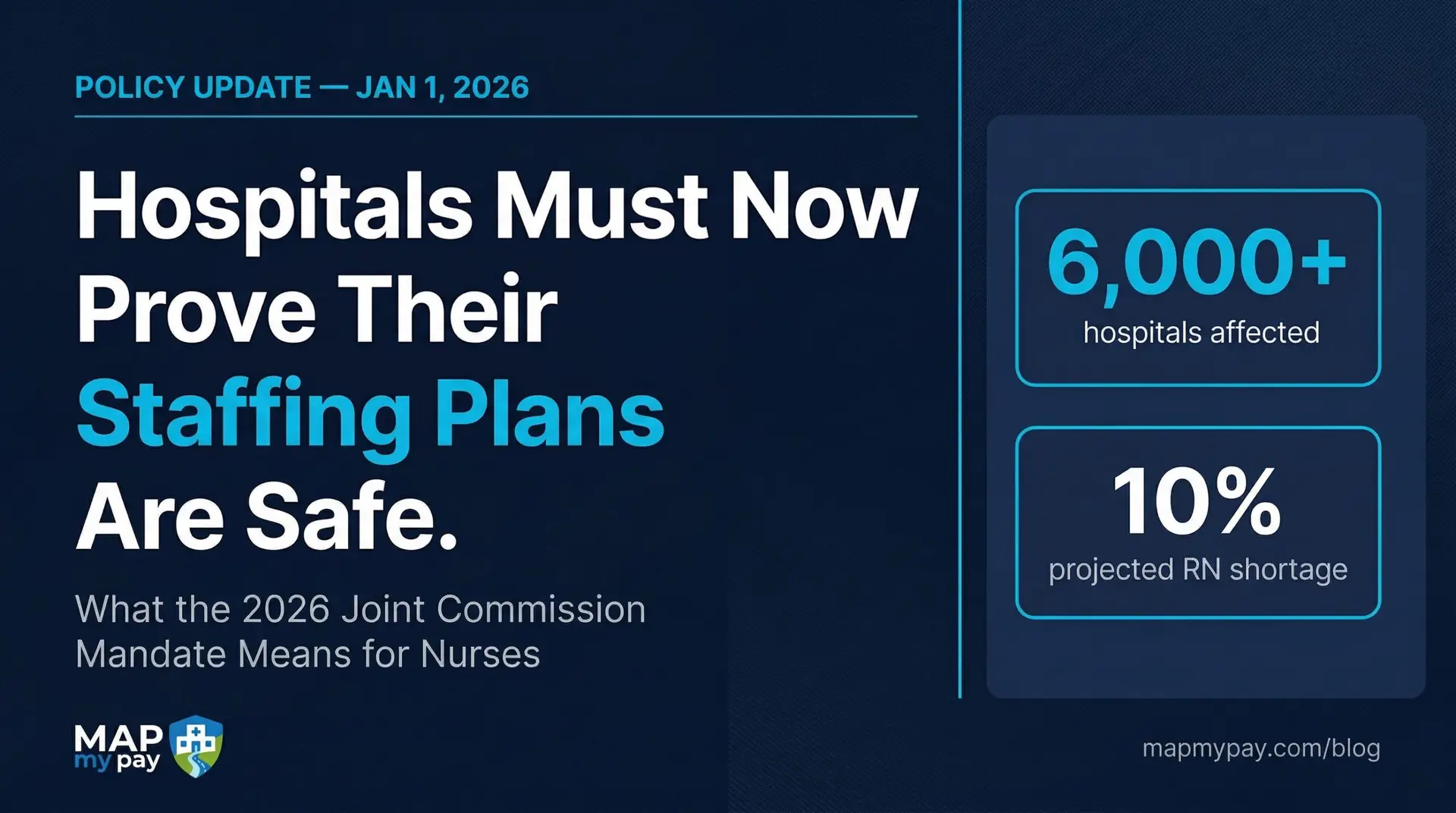
As of January 1, 2026, every Joint Commission-accredited hospital must prove its nurse staffing plan is safe — on paper, with data, tied to patient outcomes. Here is what changed, what it does not require, and what every nurse should do with this information right now.

Staff RN · Map My Pay Co-Founder · March 29, 2026
The Joint Commission just changed the rules for every accredited hospital in America. 6,000+ hospitals must now prove — not just claim — that their nurse staffing plans are safe. Intentional. Data-driven. Tied to patient outcomes.
This is the most significant shift in staffing accountability in over a decade. And most bedside nurses have no idea it happened.
Here is exactly what changed, what it does not require, what it means for your paycheck and career, and what you should do about it today.
The bottom line: Effective January 1, 2026, hospitals must document that staffing decisions are intentional, backed by data, and evaluated over time — or risk losing Joint Commission accreditation. There are no mandatory ratios yet. But for the first time, nurses have a paper trail they can point to.
What the Joint Commission Actually Changed
The Joint Commission embedded nurse staffing as a National Patient Safety Goal within its Hospital Accreditation Program, effective January 1, 2026. Before this change, staffing was evaluated loosely — hospitals pointed to written policies and called it done. There was no standardized way to evaluate whether staffing decisions were actually tied to patient safety.
Under the new standard, accredited hospitals must demonstrate that their staffing plans are:
- Intentional — decisions are deliberate and documented, not reactive to the crisis of the day
- Data-driven — tied to patient acuity, census data, and measurable outcomes
- Supported by leadership — not just a nursing department binder collecting dust
- Evaluated over time — actively reviewed, tracked, and adjusted when outcomes flag a problem
This is not a recommendation. Accreditation is how hospitals demonstrate safe care delivery to payers, regulators, and patients. For the 6,000+ hospitals that hold Joint Commission accreditation, compliance is now a condition of doing business.
What does your hospital actually pay you after taxes and rent?
What This Mandate Does NOT Require
The nursing community has been fighting for mandatory staffing ratios for years. Let’s be direct: this is not that.
There are no mandatory nurse-to-patient ratios. California remains the only state with legally required ratios — 1:5 for med-surg, 1:2 for ICU. The Joint Commission standard tracks intent and process, not a specific number on the floor. A hospital running 1:8 ratios could technically pass this standard if it documents the ratio as a deliberate, data-supported decision.
Important: Advocacy groups including National Nurses United are continuing to push for federal ratio legislation. This mandate is a foundation — not the finish line. The nurses who benefit most are the ones paying attention now.
The Nursing Shortage Behind This Policy Shift
This mandate did not come out of nowhere. The data driving it is stark. Hospitals are competing for nurses in a genuine seller’s market — and the pressure is only growing.
| Metric | 2026 Projection |
|---|---|
| National nursing supply vs. demand | 91.94% — 8.06% shortage |
| Projected RN shortage | 10% nationally |
| Projected LPN/LVN shortage | 20% nationally |
| Avg. annual RN job openings through 2030 (BLS) | 194,500 per year |
| Hospitals now under new standard | 6,000+ |
That last number is the one that matters. 6,000 hospitals. All now required to document and defend their staffing decisions. That is leverage nurses have never had before — at scale.
Why This Directly Affects Your Paycheck
Understaffing is not just a safety issue. It is a financial one — and the damage runs directly to your take-home pay.
Chronic understaffing drives mandatory overtime. Mandatory overtime drives burnout. Burnout drives nurses out of bedside roles entirely. High turnover costs hospitals between $40,000 and $60,000 per nurse replaced — costs that tighten budgets, redirect resources away from staff compensation, and create a cycle that is nearly impossible to break without external accountability.
When hospitals must document and defend every staffing decision, it creates a paper trail that nurses, unions, and regulators can reference. That is accountability that did not exist before January 1, 2026.
It also changes how you should evaluate job offers. A hospital that takes this seriously — documented processes, leadership accountability, real staffing infrastructure — is likely a better long-term financial bet. Lower turnover. Stronger culture. Conditions where you can actually build wealth instead of burning out trying to survive each shift.
What Nurses Are Actually Taking Home in 2026
Policy context matters. But numbers matter more. Here is what RNs are actually keeping after taxes and housing in major markets — pulled directly from Map My Pay’s 2026 database.
| City | RN Salary | Tax Rate | Monthly Rent | Monthly Leftover |
|---|---|---|---|---|
| Sacramento, CA | $169,210 | 34% | $2,005 | $7,340 |
| Dallas, TX | $98,740 | 21% | $1,590 | $4,879 |
| San Francisco, CA | $188,020 | 34% | $3,830 | $6,524 |
| Houston, TX | $97,810 | 21% | $1,541 | $4,873 |
| New York, NY | $104,830 | 31% | $3,200 | $2,213 |
New York has one of the most severe nursing shortages in the country — and nurses there keep less than $2,300 per month after taxes and rent. The markets with the biggest shortages are not always the ones where nurses win financially. Knowing the difference is how you use this market in your favor.
Run your city vs. any other city — free, no account required.
If You Carry Student Loan Debt, This Changes Your Math
The nursing shortage is partly a nursing education shortage. Faculty shortages and budget constraints limit how many nurses schools can graduate — which means many RNs enter the workforce carrying significant student loan debt at the exact moment they should be building wealth.
If your loans are the reason you haven’t moved to a higher-paying market — or haven’t pushed harder in a salary negotiation — refinancing can change that calculation. SoFi, Map My Pay’s financial partner, offers student loan refinancing, personal loans, and banking products built for working professionals like nurses.
How it adds up:
Refinancing $60,000 in student loans from 7% to 5% saves approximately $80/month. Over 10 years, that’s nearly $10,000 back in your pocket — without changing jobs, cities, or shifts.
What Nurses Should Do Right Now
1. Ask your manager about your hospital’s staffing plan.
Every accredited hospital must have one. Ask specifically how patient acuity is factored into staffing decisions on your unit. If they cannot answer clearly, that tells you something.
2. Document unsafe staffing conditions.
If your floor is consistently understaffed relative to patient acuity, that is now a compliance issue — not just a complaint. Keep records with dates, patient loads, and acuity. Report through your chain of command and union if applicable. The mandate gives your documentation institutional weight it did not have before.
3. Use staffing compliance as a job search filter.
Ask hospitals directly: “How does your staffing plan comply with the new Joint Commission standard?” A clear, confident answer means they’ve invested. A vague one means they haven’t. That information is worth knowing before you sign.
4. Know your market value.
Nurses who understand what they would actually take home after taxes and housing in other markets are better positioned to negotiate, relocate, or time a move. The shortage is real. Hospitals need you. Use that.
5. Address debt that’s limiting your options.
If student loans are keeping you in a market or a job that doesn’t serve your financial goals, refinancing can change the math. Check your options with SoFi — Map My Pay’s trusted financial partner for nurses.
Is your current city actually working for you financially?
See your real take-home pay versus 21,000+ cities in 30 seconds.
Frequently Asked Questions
What exactly did the Joint Commission change in 2026?
Effective January 1, 2026, the Joint Commission added nurse staffing as a National Patient Safety Goal within its Hospital Accreditation Program. All 6,000+ accredited hospitals must now document that staffing plans are intentional, data-driven, supported by leadership, and evaluated over time.
Does this mean hospitals have to follow nurse-to-patient ratios?
No. The mandate does not require specific ratios. It requires hospitals to document and defend their staffing decisions as intentional and data-driven. California is still the only state with legally mandated ratios.
How do I know if my hospital is Joint Commission accredited?
Search the Joint Commission’s Quality Check database at qualitycheck.org. Most major hospitals and health systems are accredited. If yours is, the new staffing standard applies.
What should I do if my hospital is not complying?
Document unsafe staffing conditions with dates, patient loads, and acuity levels. Report through your hospital’s chain of command. If unresolved, you can file a complaint directly with the Joint Commission at jointcommission.org. Your union can also escalate formally.
How do I see what I’d actually take home in a different market?
Map My Pay covers 21,000+ U.S. cities with real 2026 salary data, our proprietary tax engine, and housing costs from Zillow. Compare any two cities and see exactly what you’d keep per month after taxes and rent. Run your comparison here — it’s free.
🔒 Want the Full Breakdown?
VIP subscribers get:
- ✓ Hospital system staffing analysis and policy deep-dives
- ✓ Weekly city-by-city breakdowns of what nurses actually keep
- ✓ Salary negotiation data and market timing insights
🏥 Map My Pay is now available on the Apple App Store and Google Play.
Here’s what you get inside:
- ✅ After-tax nursing salaries across 21,000+ U.S. cities
- ✅ Leftover income after rent or mortgage, calculated for your role
- ✅ Crime stats, school ratings, and cost-of-living data in one place
- ✅ See how your current city stacks up against anywhere in the country
Gross salary is what the hospital pays you. Net salary after taxes and housing is what you actually live on. Map My Pay shows you both — free, no account required.
Is your hospital actually complying with the new Joint Commission standard — or just checking boxes? Have you seen any changes on your floor since January? Drop it in the comments.
Map My Pay provides data-driven financial intelligence for nurses across 21,000+ U.S. cities. All salary data uses our proprietary 2026 tax engine including federal brackets, FICA, state income tax, and SDI where applicable. Housing data sourced from Zillow. This post contains a partnership link to SoFi. Map My Pay may receive compensation if you apply through our link. All financial decisions should be evaluated based on your individual circumstances.